


Deer-vehicle accidents differ from other car accidents in a number of ways. For example, the time of year influences the frequency of these types of incidents as does your location.
In any case, there are a number of safety measures and mindsets that you can take that will help reduce your chances of experiencing this as well as reduce its impact should it happen anyway.
Where Are Deer-Vehicle Accidents Most Likely?
Generally, the northern part of the country is where deer-vehicle accidents are more likely to occur. The states with the highest rates are usually Montana, Wyoming, North Dakota, South Dakota, Iowa, Minnesota, Wisconsin, Michigan, Pennsylvania and Maine while Kansas’ rates tend to be high as well.
As for where the rates tend to be the lowest, Western U.S. states populate much of that list, including Washington, California, Nevada, Arizona and Hawaii. Rates are also low in Florida, New Jersey and Connecticut.
When Are Deer-Vehicle Accidents More Common?
Deer-vehicle accidents are much more common in the latter months of the year, with the year’s low rate in August steadily rising in September and even more so in October and November before dropping in December. That said, the year’s final month is still the one with the second-highest rates, after November.
The main reason this time of year has high collision rates is that it is deer-mating season, which results in roads being crossed by deer much more often than at other times of the year. Also, they tend to be much less cautious when doing so during this season.
The time of day when deer are most often crossing roads also plays a role in why those months have such high rates. That is because these types of crashes are most common around dawn and sunset, and sunset coincides much more closely with rush hour during the year’s final months than it does at most other points of the year.
Also of note, deer tend to be more active and enter roadways more often during full moons as contrasted with when skies are darker.
In any case, do keep in mind that these types of collisions can and do happen throughout the year at all times of the day and night.
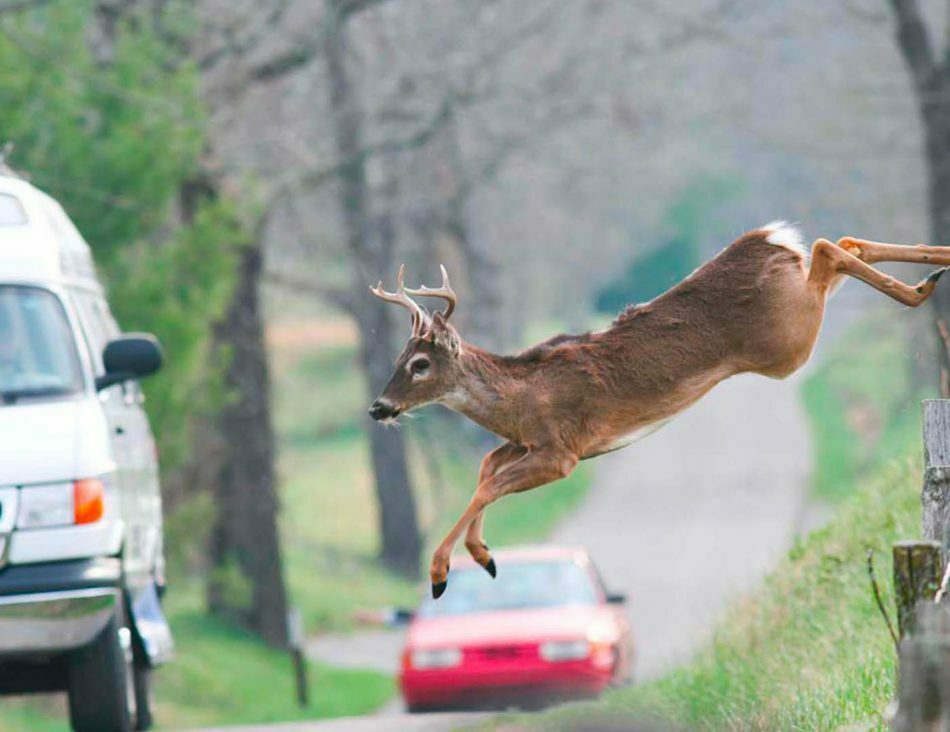
Why You Should Resist Swerving to Avoid Hitting Deer
Another example of how deer-vehicle accidents differ from other kinds is that you should do your best to not swerve in an attempt to avoid hitting a deer.
Yes, it is true that it is best to avoid hitting a deer if the other option is not crashing into anything. The issue is that in many circumstances, when someone swerves to avoid an impact with a deer, they end up in the path of oncoming traffic or off of the road into conditions that are ultimately much worse than a deer impact would have been.
For that reason, it is often better to not swerve in order to avoid experiencing even more dangerous scenarios. In fact, many governmental agencies use the slogan “Don’t veer for deer” to make that advice as memorable as possible to drivers.
Also be wary of braking sharply if you have cars close behind you.
Should You Honk Your Horn?
Some recommend honking the horn in an attempt to avoid an impact with a deer. However, it is not that simple. Yes, it is true that honking is much more likely to cause a deer to move as compared to flashing your lights or similar actions. The issue is that where the deer moves could be dangerous, such as if it is off the road and then, startled, runs into your lane of traffic or if it is already in your lane and then runs into a different lane.
What To Do if You Hit a Deer
Should you hit a deer, call 911 and check if any potentially impacted drivers, passengers or pedestrians have suffered injuries. If able to, move your vehicle away from traffic. Also, if the deer is still on the road and you can safely block that lane, do so.
Do not approach the deer.
If it is still alive, it can be dangerous to approach it, both to you and potentially other drivers if it then panics and takes off in front of the paths of other vehicles. If it has died, it is often best to wait for professionals to remove it from the scene, but if you want to keep it, whether for food, its hide or other reasons, you often can. Ask the officer on scene if this can be legally done and, if yes, for any steps that you need to take first.
Take pictures or videos of the scene, including any vehicle damage, the deer’s position and skid marks. Also take notes. This information will help if you decide to file an insurance claim.
Once everything has been handled at the scene, you can head home if your vehicle is safe to drive. But do check for any fluid leaks, tire damage, windshield cracks and broken headlights. Also see if your radiator is damaged.
You should also call your insurance company right away, generally within 24 hours. You may also want to reach out to an experienced car accident lawyer like the attorneys at Edwards Law Office, P.C. at this time.
Conclusion
A deer-vehicle accident involves several factors that are usually not involved in other types of car accidents. These include the fact that swerving can make things worse and that an injured or dead deer can cause another accident if it remains in a lane with inadequate warning being provided to other drivers. Also, the risk of a deer collision increases significantly during certain times of the year and of the day.
In addition, some insurance companies will treat this under comprehensive coverage as opposed to collision coverage.
In any case, a car accident lawyer can help you navigate this process once the scene has been cleared and you have made your way home.