GRP decking anti-slip strips offer a quick and effective solution to enhance safety on slippery wooden decking, providing excellent traction in wet, damp, and frosty conditions while maintaining an aesthetically pleasing appearance.
Safety Enhancement Mechanisms
GRP (Glass Reinforced Plastic) strips significantly enhance safety on decking and other potentially slippery surfaces through several key mechanisms and should be combined with other safety measures wherever possible, including handrails:
- High-traction surface: The strips feature a textured, grit-embedded surface that provides excellent grip underfoot, even in wet or icy conditions. This high-friction surface dramatically reduces the risk of slips and falls.
- Durable anti-slip properties: Unlike painted or coated anti-slip solutions, the quartz or aluminum oxide grit in GRP strips is embedded throughout the material. This ensures long-lasting slip resistance that doesn’t wear away over time, maintaining safety for years.
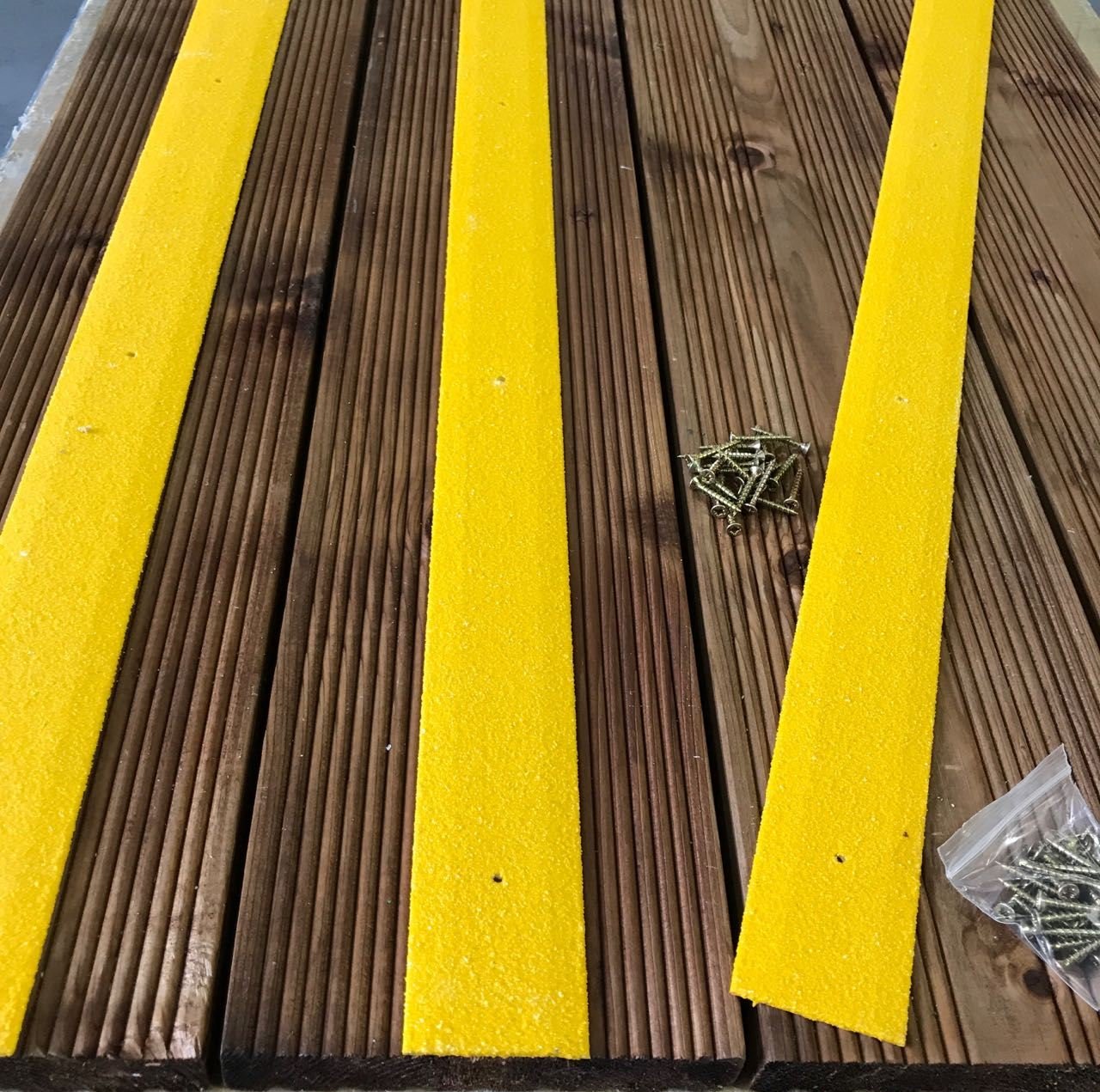
- Visual warning: GRP strips can be manufactured in high-visibility colors like yellow, providing a clear visual cue to users about potential slip hazards. This visual warning helps alert people to exercise caution in potentially dangerous areas.
- All-weather performance: GRP strips maintain their slip-resistant properties across a wide range of temperatures and weather conditions. They are resistant to UV degradation, ensuring consistent performance in outdoor applications.
- Chemical resistance: The composite nature of GRP makes it resistant to many chemicals, oils, and solvents. This means the strips retain their safety properties even in environments where spills or contamination might occur.
- Moisture barrier: By creating a waterproof seal on wooden decking, GRP strips prevent water absorption into the wood. This not only protects the underlying structure but also helps maintain a drier, safer surface.
- Fire resistance: Many GRP strips are manufactured with fire-resistant additives, achieving ratings like Euro Class 1. This adds an extra layer of safety in the event of a fire, potentially slowing its spread.
- Corrosion resistance: Unlike metal alternatives, GRP strips do not corrode or rust. This ensures they maintain their structural integrity and safety features even in harsh environments or coastal areas.
By combining these properties, GRP strips create a comprehensive safety solution that addresses multiple hazards simultaneously, significantly improving the overall safety of decking and other potentially slippery surfaces.

Installation Techniques for GRP Strips
GRP decking strips are typically installed using mechanical fixings or adhesives, with a combination of both methods often recommended for optimal results.
- Tools needed: drill, screwdriver, hacksaw or jigsaw (for cutting), and adhesive applicator.
- Recommended fixing intervals: 50mm from ends, 250-300mm along length.
- Surface preparation: clean, dry, and repair any damage.
- Adhesive application: 6mm bead around perimeter and diagonal cross lines for wider strips.
- Cutting options: hacksaw, jigsaw, or angle grinder with appropriate blade.
For mechanical fixing, pre-drill holes in the strips at approximately 50mm from each end and at 250-300mm intervals along the length.
Use appropriate screws, ensuring they are slightly longer than the plug length for concrete substrates. When using adhesive, apply a 6mm bead around the perimeter of the strip, 15mm from the edges, and in diagonal cross lines for wider strips. For a 50mm wide strip, approximately 60ml of adhesive per linear meter is sufficient.
Always prepare the surface by cleaning and repairing any damage before installation. Dry-fit the strips first to ensure proper placement and cut them to size if necessary using a hacksaw, jigsaw, or angle grinder.
Weather-Resistant Properties of GRP
GRP (Glass Reinforced Plastic) decking strips offer exceptional weather resistance, making them ideal for outdoor applications. These strips are highly durable and can withstand extreme temperatures ranging from -20°C to 80°C.
- Corrosion-resistant and will never rust.
- Thermally stable across a wide temperature range.
- Resistant to algae, mold, and moss growth.
- Minimal maintenance required to maintain effectiveness.
- Long-lasting solution, with some manufacturers offering up to 10-year guarantees.
These weather-resistant properties ensure that GRP decking strips maintain their slip-resistant qualities and structural integrity year-round, providing a long-term safety solution for outdoor decking areas.
Comparing GRP Grades for Safety
When selecting GRP (Glass Reinforced Plastic) grating for safety applications, it’s crucial to understand the different grades available and their specific properties.
GRP grating is engineered to meet various British and European Standards, ensuring high levels of safety and performance.
- Fire resistance: GRP grating can be manufactured with different resin types to achieve specific flame spread ratings.
- Slip resistance: Many manufacturers offer grating with various levels of anti-slip finishes, such as quartz grit surfaces, to provide enhanced traction in wet or oily conditions.
- Corrosion resistance: All grades of GRP grating offer excellent resistance to corrosion, making them ideal for use in harsh chemical environments or coastal areas.
- Load-bearing capacity: Different grades can offer varying levels of strength and stiffness, allowing for selection based on the anticipated foot traffic or equipment loads.
- UV stability: Some GRP grades are specifically formulated to resist degradation from prolonged sun exposure, ensuring long-term performance and safety in exterior settings.
By carefully comparing these factors across different GRP grades, you can select the most appropriate option for your specific safety requirements and environmental conditions.
Surface Preparation for GRP Installation
Surface preparation is crucial for the successful installation of GRP (Glass Reinforced Plastic) decking strips and flooring. The substrate must be clean, dry, and stable to ensure proper adhesion and longevity of the GRP material.
- Remove all dirt, grease, oil, and loose particles from the surface.
- Repair any damage or undulations in the substrate to create a flat, even surface.
- For concrete surfaces, ensure sufficient surface strength; if inadequate, mechanical fixing may be necessary.
- Allow the surface to dry completely before installation.
- For wooden decking, sand the surface lightly to improve adhesion.
- If using adhesive, clean both the substrate and the underside of the GRP strips.
Proper surface preparation not only enhances the bond between the GRP and the substrate but also minimizes potential issues such as ‘drumming’ noise when walked upon, which can occur if the surface is not entirely flat.
Taking the time to properly prepare the surface will significantly improve the performance and lifespan of your GRP installation.
Moisture Barrier Capabilities
GRP (Glass Reinforced Plastic) decking strips not only provide excellent slip resistance but also serve as an effective moisture barrier, enhancing the longevity and safety of wooden decking structures.
The composite nature of GRP, combining glass fibers with polyester resin, creates a waterproof surface that prevents moisture penetration. This waterproof quality is essential for decking applications, as it helps to:
- Prevent water absorption into the wood, reducing the risk of warping and splitting.
- Inhibit the growth of mold, algae, and fungi that thrive in damp environments.
- Maintain the structural integrity of the decking by protecting it from moisture-related deterioration.
GRP decking strips are designed to be seamless and non-porous, effectively sealing the surface of the wood. This seamless construction eliminates gaps or joints where water could potentially seep through, providing comprehensive protection across the entire treated area.
The moisture barrier properties of GRP strips are particularly beneficial in areas prone to high humidity, frequent rainfall, or near bodies of water.
By preventing water ingress, these strips help to maintain a dry, safe walking surface even in challenging weather conditions. Proper installation is crucial to maximize their effectiveness.
Ensuring a tight seal between the strips and the wooden decking surface is essential for optimal moisture barrier performance.
When correctly installed, GRP decking strips can significantly extend the lifespan of wooden decking by protecting it from moisture-related damage, ultimately enhancing both safety and durability.