Introducing your child to swimming can be an important step towards building water confidence, exploring movement, and developing essential aquatic skills and water safety habits.
However, babies and young children have different needs, so choosing the right lessons involves understanding their individual development, readiness, and comfort around water.
For parents, the goal is not to rush children into learning swimming techniques. It is to provide positive, age-appropriate experiences that encourage exploration, build familiarity with water, and support children as they gradually develop new skills.
When Should Babies Start Swimming Lessons?
There is no single age that suits every baby. Some swimming programs accept babies from around two to six months of age, although the minimum age varies between providers. Parents should check the program requirements and seek advice from their healthcare professional if they have concerns about their baby’s health or readiness.
Age alone should not determine when a baby begins swimming lessons. Their individual development, health, comfort, and the suitability of the pool environment are equally important considerations.
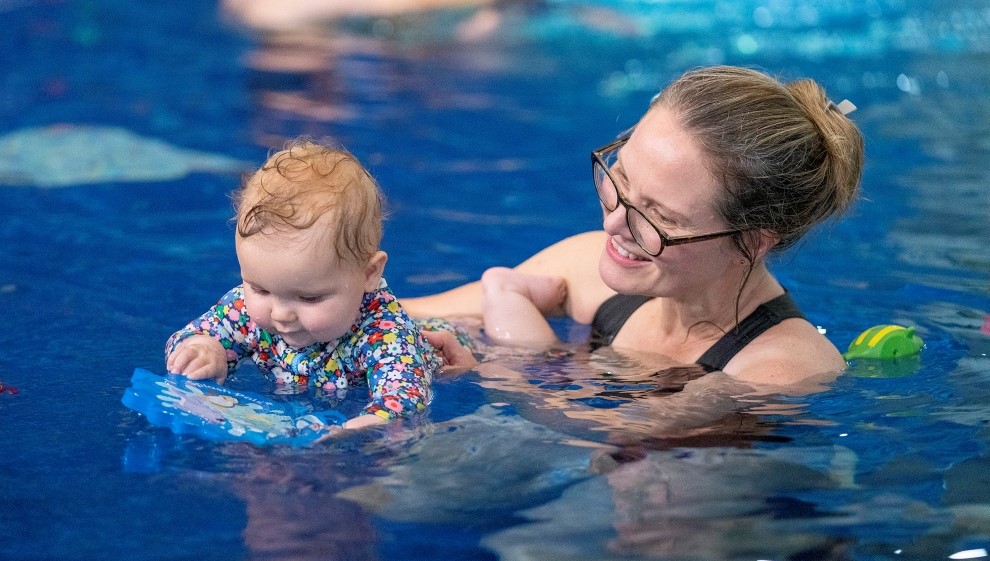
At this stage, lessons generally focus on water familiarisation, supported movement, sensory exploration, and positive interaction between the baby and parent. Babies are not expected to swim independently or learn advanced techniques.
Before enrolling, consider your baby’s individual needs and whether the program provides an environment where they can participate comfortably, with appropriate support and without pressure to achieve specific milestones.
What Happens During Baby Swimming Lessons?
Early sessions are usually designed around simple activities that introduce babies to water through supported exploration. Depending on the program, these may include splashing, reaching for floating toys, experiencing buoyancy, supported floating positions, and discovering different ways their bodies can move in water.
Parent participation is an important part of the experience. Staying close to a familiar caregiver can help babies feel secure while exploring a new environment. It also provides opportunities for parents to observe their baby’s responses and learn to recognise signs of comfort, curiosity, uncertainty, or tiredness.
A responsive approach allows activities to be adapted according to each baby’s cues. If a baby becomes unsettled or overwhelmed, the instructor may suggest changing the activity, offering additional reassurance, or taking a break rather than encouraging participation through distress.
Parents considering baby swim classes should look for programs with instructors experienced in working with infants, appropriate pool conditions, individual attention, and clear safety procedures.
The emphasis should be on positive water experiences, trust, and discovery rather than forced submersion or achieving specific swimming milestones at a particular age.
How Swimming Lessons Change as Children Grow
As babies develop into toddlers and preschool-aged children, their learning needs change. They become more mobile, increasingly aware of their surroundings, and gradually develop the ability to explore movements with greater independence.
Lessons may gradually introduce:
- Kicking, reaching, turning, and exploring basic arm movements.
- Supported floating, buoyancy, balance, and body positioning.
- Breath awareness and age-appropriate breathing activities.
- Moving short distances through the water with appropriate support.
- Discovering how to change direction and return to a safe position or pool edge.
- Safe pool entry and exit behaviours.
The exact skills introduced will depend on the child’s development, ability, previous experience, and emotional readiness.
Rather than focusing only on learning strokes or completing prescribed movements, effective lessons encourage children to explore how their bodies interact with water. Through repetition, curiosity, and play, they can gradually discover how to control their movements, maintain balance, and navigate the aquatic environment.
Instructors should adapt activities to each child’s readiness rather than expecting every child to progress at the same pace.
Benefits of Swimming During Early Childhood
Swimming offers several opportunities for physical activity, sensory exploration, and learning during the early years.
Physical development: Kicking, reaching, floating, turning, and moving through water encourage children to explore different movements, practise