


Understanding Real Property Assessments and Market Value
To effectively challenge an assessment, one must first understand that the figure on your tax bill is not necessarily the “market value” of your home. Instead, it is an assessed value derived from a complex interplay of municipal budgets, equalization rates, and statutory guidelines.
In Suffolk County, and specifically within the Town of Southampton, the assessment roll is the baseline from which your tax liability is calculated.
Your property’s assessed value is intended to reflect a specific percentage of its market value as of a set valuation date—typically July 1st of the year prior to the tax cycle. Because market conditions fluctuate, the gap between your home’s assessed value and its actual, current market worth can widen over time.
This is where the opportunity for a grievance arises. If the town’s records do not accurately reflect the physical reality or the economic value of your property, you are likely overpaying.
Converting Assessed Value via the Residential Assessment Ratio
To determine if you are overassessed, you must translate your assessed value into an “indicated market value.” This is done using the Residential Assessment Ratio (RAR). The RAR is the percentage of market value at which properties are assessed in your specific municipality.
To find your indicated market value, divide your property’s assessed value by the current RAR for your town.
For instance, if your assessment is a certain dollar amount and the RAR is a small decimal, the resulting figure represents what the town believes your home is worth. If this calculation yields a number significantly higher than what your home would realistically sell for on the open market, you have a strong basis for a grievance.
This process is most effective when performed after the tentative assessment roll is published each May, allowing you to compare the town’s valuation against recent, verifiable market data.
Identifying Municipal Assessment Discrepancies
West Hampton properties are subject to the assessment standards of the Town of Southampton. Discrepancies often occur because mass appraisal systems—used by assessors to evaluate thousands of homes simultaneously—cannot account for the unique nuances of every property.
Factors such as proximity to high-traffic areas, specific structural defects, or outdated interior finishes are often overlooked by automated valuation models. By identifying these disparities, you can present a compelling argument that your property is being valued unfairly compared to neighboring homes with similar characteristics.
Core Legal Strategies for Property Tax Reduction

The path to tax relief generally follows a two-tiered approach: administrative relief and judicial review. Administrative relief is the first and most accessible step, involving a formal complaint filed with the Board of Assessment Review (BAR). This body acts as an independent panel, separate from the assessor’s office, tasked with hearing the grievances of taxpayers.
If the BAR denies your request or provides insufficient relief, you may pursue judicial review through the Small Claims Assessment Review (SCAR) process. This is a streamlined, low-cost legal proceeding that allows homeowners to present their case to a court-appointed hearing officer.
Both strategies rely heavily on the strength of your evidence, making the preparation phase the most critical part of the process.
Filing Administrative Tax Grievances with the Board of Assessment Review
The primary vehicle for your challenge is Form RP-524. This document requires you to state your opinion of the property’s market value and provide the evidence to support it. When you file this form, you are formally requesting a review of your assessment.
For those looking to reduce their property taxes, the administrative phase is an opportunity to negotiate a stipulation. A stipulation is a formal agreement between you and the assessor to lower your assessment without the need for a full hearing.
This is often the fastest route to success, as it resolves the discrepancy early in the cycle and provides immediate clarity for your upcoming tax bill.
Pursuing Judicial Appeals Through Small Claims Assessment Review
If the administrative process does not yield a fair result, the SCAR process offers a second chance. Under Section 730 of the Real Property Tax Law, homeowners can file a petition to have their assessment reviewed by an independent referee. The filing fee is intentionally kept low to ensure access to justice for residents.
The referee’s decision is binding on the municipality, and if the petition is successful, the town must correct your assessment and issue a refund for any overpaid taxes.
Developing Evidentiary Proof to Support Assessment Challenges
The burden of proof rests entirely on the homeowner. You cannot simply claim your taxes are too high; you must demonstrate that your property is overassessed through objective, market-based data.
This evidence must be relevant to the valuation date used by the town and should be organized to clearly highlight the difference between your current assessment and the market reality.
Comparable Sales Analysis for Property Tax Reduction

A Comparable Market Analysis (CMA) is the gold standard for proving overassessment. By identifying three to five homes in your immediate vicinity that have sold recently and share similar square footage, lot size, and construction style, you can establish a “market ceiling” for your own property.
When conducting this analysis, remember to account for differences. If your neighbor’s home sold for a higher price but includes a luxury pool or a finished basement that you lack, you must adjust the sale price downward to reflect the value of those missing features. This detailed, comparative approach is what distinguishes a successful grievance from a rejected one.
Independent Appraisals and Condition Reports for Property Tax Reduction
Sometimes, market data alone is not enough, especially if your home has unique characteristics or significant deferred maintenance. An appraisal from a licensed professional provides an authoritative, third-party valuation that is difficult for a board to ignore. An appraiser will physically inspect your property, document its condition, and provide a report that accounts for physical depreciation, environmental factors, and market trends. This report serves as powerful evidence that your home’s value is lower than the town’s estimate.
Navigating Municipal Tax Grievance Deadlines and Procedures
Timing is non-negotiable in the grievance process. In the Town of Southampton, which governs West Hampton, Grievance Day is held on the third Tuesday in May.
Your completed Form RP-524 must be received by the Assessor’s Office or the Board of Assessment Review by this date. Failure to meet this deadline results in the forfeiture of your right to challenge the assessment for that year.
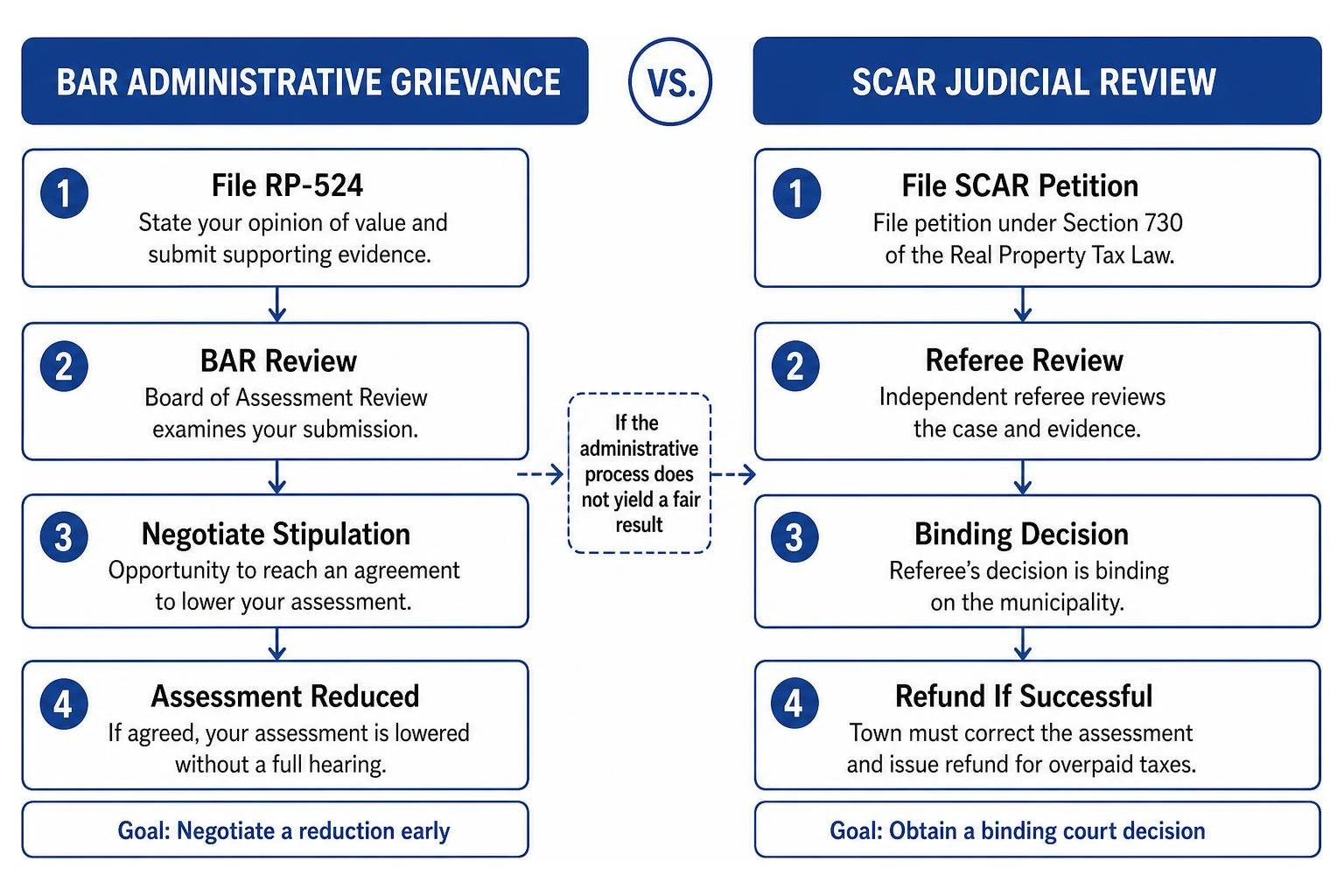
The following table summarizes the differences between the two primary avenues for relief:
| Feature | BAR Administrative Grievance | SCAR Judicial Review |
|---|---|---|
| Primary Goal | Negotiate a reduction early | Obtain a binding court decision |
| Cost | No filing fee | Nominal court filing fee |
| Timing | Third Tuesday in May | Within 30 days of final roll |
| Authority | Board of Assessment Review | Court-appointed hearing officer |
Frequently Asked Questions about Property Tax Reduction
Can challenging a property assessment cause tax rates to increase?
No. Filing a grievance challenges the assessed value of your property, not the tax rate itself.
Tax rates are determined by municipal budgets and are applied to the total taxable value of the entire town. A successful grievance may lower your individual assessment, but it does not trigger an increase in the tax rate for you or your neighbors.
What documentation provides the strongest evidence before the Board of Assessment Review?
The most effective documentation includes recent, arm’s-length sales of comparable properties and professional appraisals. Closing statements from your own recent purchase, if applicable, or documented evidence of structural issues (such as photos of water damage or foundation cracks) can also serve as strong supporting evidence to prove that your home’s market value is lower than the town’s current assessment.
What is the typical timeline for securing assessment relief?
The process begins with the release of the tentative assessment roll on May 1st. You must file your grievance by the third Tuesday in May.
The Board of Assessment Review typically issues decisions in the summer, and the final assessment roll is filed in the fall.
If you are successful, the reduction is reflected in the tax bills issued in December, and any overpaid amounts are generally adjusted or refunded accordingly.
Conclusion
Securing a property tax reduction is not a one-time event but a strategic part of responsible homeownership.
By staying informed about your property’s assessed value, monitoring local market trends, and adhering to the strict deadlines set by the Town of Southampton, you can ensure that your tax burden remains fair and equitable.
While the process requires diligence and careful preparation, the long-term financial benefits of a successful grievance are well worth the effort.
By taking a proactive approach to your assessment, you are not just managing a bill—you are protecting your investment in your home and your financial future.


