


Key Takeaways
- A repaired vehicle may still sell for less than a similar vehicle with no reported accident history.[1]
- Repair cost and lost market value measure different things.
- Accurate comparisons should match the vehicle’s year, trim, mileage, options, condition, and Colorado market area.
- Repair invoices, photographs, history reports, and valuation documents can help explain a vehicle’s condition and pricing.
- Rules concerning insurance claims and diminished value can depend on the facts, policy language, and applicable law.
A collision can affect more than a vehicle’s appearance and repair bill. For Colorado owners, from Front Range commuters to drivers who regularly travel mountain corridors, an accident may change what a future buyer is willing to pay.
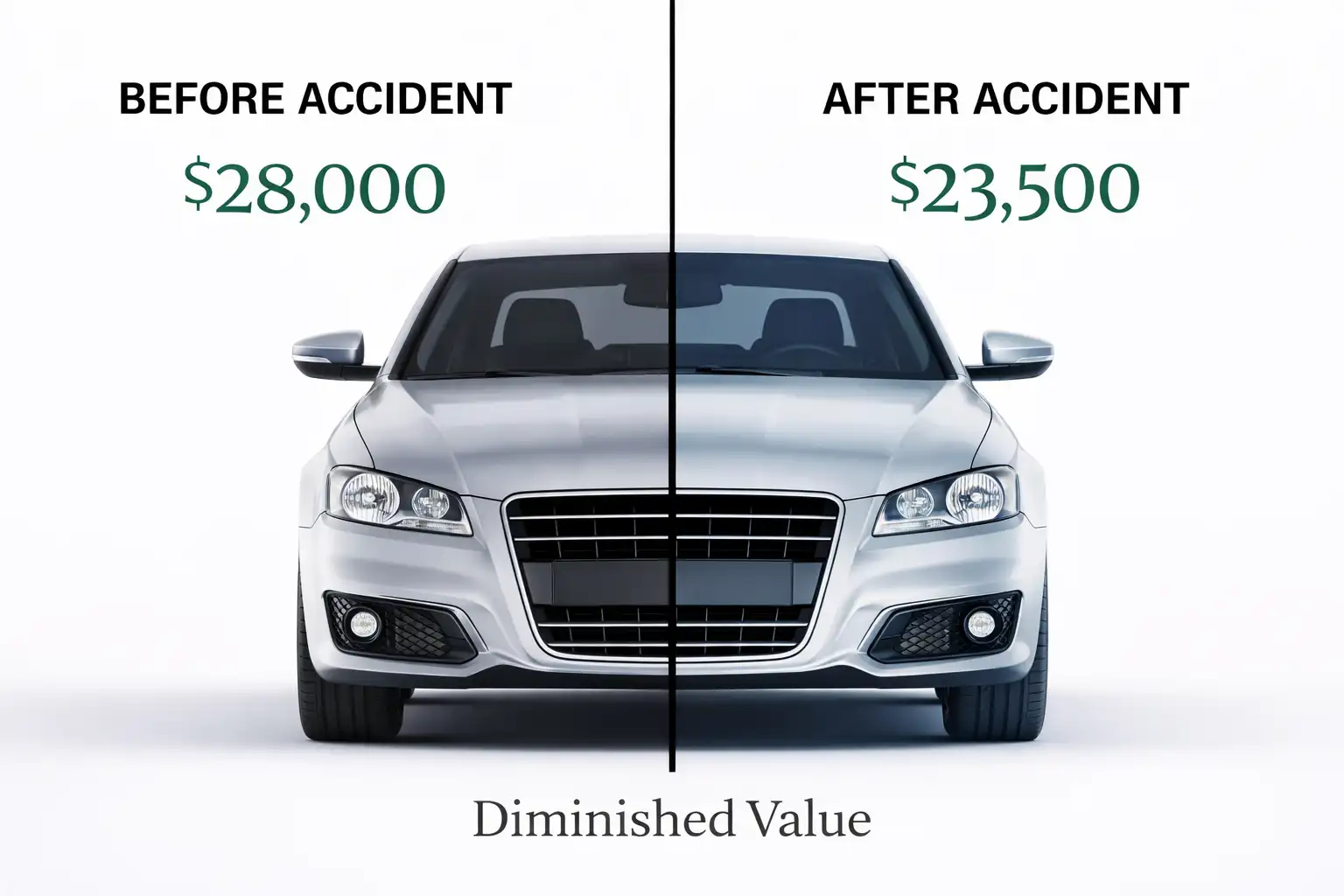
A Colorado diminished value claim concerns the possible reduction in resale value after repairs, rather than the cost of fixing the physical damage.
The amount of any value change depends on the individual vehicle and the local market. Mileage, trim, pre-crash condition, repair documentation, accident severity, title status, and comparable listings in areas such as Denver, Colorado Springs, Fort Collins, or Grand Junction can all matter. Careful records help replace broad assumptions with evidence tied to the vehicle.
What Market Value Means After a Crash
Market value is the amount a willing buyer may pay for a particular vehicle in its current condition. It is not necessarily the original purchase price, the remaining loan balance, the replacement cost, or the total amount paid by an insurer for repairs. Insurers commonly use actual cash value when evaluating a total-loss vehicle, and understanding how insurers calculate a vehicle’s cash value can help owners identify the information that affects a valuation.
Consider two otherwise similar SUVs offered in the same Colorado community. If one has a clean history and the other has a documented collision followed by repairs, buyers may treat them differently. The difference is not automatic or fixed, but the accident history can influence the offers sellers receive.
Why Repairs Do Not Always Restore Resale Value
Quality repairs can restore a vehicle’s operation and appearance, but they may not remove every buyer’s concern. Prospective purchasers may ask whether damage extended beyond visible panels, whether safety systems were inspected, or whether replacement parts matched the original equipment. A dealer considering a trade-in may also account for the time and uncertainty involved in reselling a vehicle with an accident record.
Vehicle-history information deserves a close review. A report can be useful, but it may not contain every repair, collision, or maintenance event.
The federal National Motor Vehicle Title Information System explains that title-history reports can flag certain brands and total-loss information, but do not provide a complete repair history.[2] Comparing a report with shop invoices and photos can give a more complete picture.
The Factors That Can Shape a Vehicle’s Value
Age, Mileage, and Condition
A newer or lower-mileage vehicle may have a higher pre-crash market value, making the price difference more noticeable in dollars.
At the same time, a high-mileage vehicle may already face reduced buyer demand because of ordinary wear.
Maintenance history, tire condition, interior wear, and prior cosmetic issues should be considered before treating an accident as the only cause of a lower price.
Severity and Type of Damage
A minor bumper repair may be viewed differently from damage involving airbags, suspension components, multiple body panels, or structural areas. The repair estimate, final invoice, parts list, alignment documentation, and post-repair inspection records can help clarify what occurred.
A vehicle with a salvage or rebuilt title presents a separate issue from a vehicle with a repaired accident and a regular title.
Trim, Features, and Local Demand
Colorado comparisons should account for the exact model and trim. All-wheel drive, towing equipment, advanced driver-assistance features, battery condition in an electric vehicle, and specialized off-road packages may affect local demand. Seasonal conditions can also influence listings.
A four-wheel-drive vehicle in a mountain community may not be directly comparable to a two-wheel-drive version advertised elsewhere.
How to Build a Reasonable Value Estimate
- Document the vehicle before the crash. Save photographs, service records, old listings, purchase documents, mileage records, and evidence of options or upgrades.
- Keep the complete repair file. Retain estimates, invoices, receipts, parts information, diagnostic results, and inspection notes.
- Find close local comparisons. Look for the same year, make, model, trim, body style, drivetrain, mileage range, and general condition.
- Separate asking prices from completed sales. A listing reflects a seller’s requested price, not necessarily the price accepted by a buyer.
- Look for patterns. Several closely matched listings can be more informative than one unusually high or low vehicle.
- Record meaningful differences. Note why each comparison is stronger or weaker, including mileage, equipment, location, title history, and visible condition.
A Simple Comparison Example
Suppose a clean-history vehicle with comparable mileage, trim, and equipment is listed locally for $24,500, while a similar vehicle with a disclosed repaired collision is listed for $21,900. The $2,600 gap does not establish a precise loss on its own.
The cars may differ in condition, tires, options, seller type, or time on the market. Still, recurring gaps between well-matched vehicles may indicate a market pattern worth documenting.
Reviewing an Insurer’s Valuation
If an insurer provides a valuation report, check each underlying detail. Confirm the year, model, trim, mileage, factory options, condition assessment, and geographic area. Review whether the comparisons have similar accident and title histories. An incorrect trim level, omitted package, or distant comparison can affect how useful the report is for the specific vehicle.
Ask for an explanation of adjustments and retain copies of all emails, letters, estimates, and reports. A concise written response that identifies specific errors and provides better comparisons is generally easier to evaluate than an unsupported disagreement.
Diminished Value, Total Losses, and Insurance Rates
A diminished-value question generally involves a repaired vehicle that may have less resale appeal after an accident. A total-loss valuation instead focuses on the vehicle’s value immediately before the loss. These are different calculations and should not be blended together simply because both arise after a crash.
Resale value is also separate from a driver’s premium. Insurance pricing can consider underwriting factors and driving history, while market value concerns the vehicle as property. Information about how accident history may influence insurance rates can help keep those two subjects distinct. Eligibility for any diminished-value payment can vary based on the claim type, fault, insurance policy, and governing rules.

Common Mistakes to Avoid
- Using the original purchase price as the vehicle’s present value.
- Assuming a large repair bill equals an equal loss in market value.
- Comparing different trims, body styles, drivetrains, or mileage ranges.
- Relying on a single online estimate or distant listing.
- Failing to preserve repair records and pre-crash photographs.
- Overlooking title brands or discrepancies in vehicle-history information.
Conclusion
An accident can influence a Colorado vehicle’s market value even after competent repairs are complete.
The most useful assessment starts with the vehicle’s actual characteristics, its documented repair history, and comparable local vehicles.
By carefully reviewing an insurer’s report and organizing supporting records early, owners can make decisions based on clearer market evidence rather than assumptions.
References
[1] Wells-Dietel, Brenda P., Asligul Erkan-Barlow, and William Walkowiak. “Automobile Diminished Value Claims.” Journal of Insurance Regulation, 2023. The article examines diminished value in automobile insurance and identifies factors that can affect it, including vehicle-related and intangible factors. https://content.naic.org/research/jir/automobile-diminished-value-claims
[2] U.S. Department of Justice, Bureau of Justice Assistance. National Motor Vehicle Title Information System (NMVTIS): Frequently Asked Questions. NMVTIS provides title, brand, odometer, theft, salvage, and total-loss information, but does not contain a vehicle’s repair history. https://vehiclehistory.bja.ojp.gov/faq/list


