


The 6.7 Powerstroke sits firmly in the latter category, a turbocharged workhorse that has powered heavy-duty trucks through decades of serious work, earning a passionate following among diesel enthusiasts, fleet operators, and everyday truck owners alike.
But like every factory-built diesel, its factory programming reflects a careful balance between performance, emissions compliance, fuel efficiency, and durability across a wide range of operating conditions.
For owners seeking to push beyond these factory boundaries, whether for competitive use or specialized towing, understanding the impact of modifications, including deleted 6.7 Powerstroke HP gains and the role of a 6.7 Powerstroke delete kit, is essential knowledge. This guide breaks it all down.
The 6.7 Powerstroke: Built for Serious Work
First introduced in 2011, the 6.7-liter turbocharged diesel engine represented a significant engineering evolution. Unlike its predecessors, it was designed in-house rather than sourced from an outside manufacturer, which gave engineers far greater control over performance characteristics and integration with the vehicle’s systems.
Over multiple generations, output has climbed steadily from around 390 horsepower and 735 pound-feet of torque in early versions to well over 475 horsepower and 1,050 pound-feet of torque in later models. On paper, these are impressive figures, and in practice, they deliver class-leading towing and hauling capability.
However, these numbers represent the engine in its factory emissions-compliant state. The mechanical foundation of the 6.7 Powerstroke holds additional potential that, with appropriate modifications, can be unlocked.
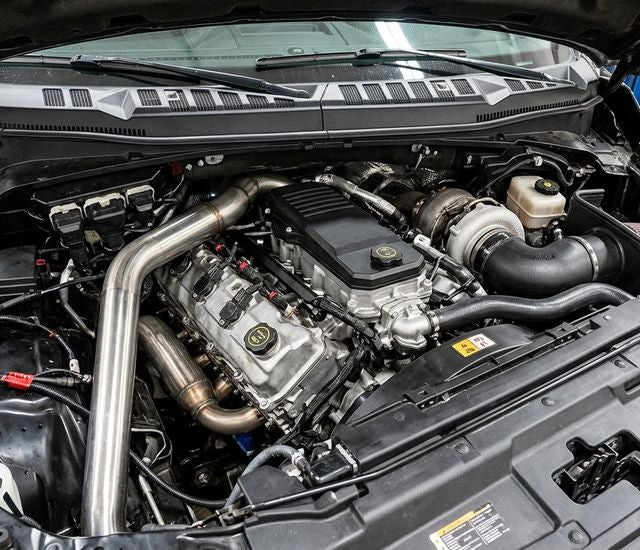
What Emissions Systems Do to Performance
Modern diesel engines are equipped with a suite of emissions control systems designed to reduce pollutants from the exhaust. The 6.7 Powerstroke carries several of these, including an Exhaust Gas Recirculation (EGR) system, a Diesel Particulate Filter (DPF), and a Selective Catalytic Reduction (SCR) system that uses Diesel Exhaust Fluid (DEF). While effective at reducing emissions, these systems introduce certain trade-offs.
The EGR system recirculates a portion of exhaust gases back into the intake manifold, which reduces combustion temperatures but can, over time and under severe duty cycles, contribute to carbon buildup in the intake manifold. The DPF captures particulate matter and requires periodic regeneration, which raises exhaust temperatures and consumes additional fuel.
In high-mileage or severe-service applications, the DPF can become a maintenance item that requires attention. For owners operating trucks in demanding environments, high mileage, heavy towing, frequent stops and starts, these systems don’t just impact performance; they can become reliability considerations.
Understanding the 6.7 Powerstroke Delete Kit
A 6.7 Powerstroke delete kit is an aftermarket solution designed to remove or bypass the factory emissions control systems, specifically the EGR, DPF, and sometimes the DEF/SCR system. The kit typically includes replacement pipes, block-off plates, and supporting hardware, which can physically eliminate these components from the exhaust and intake systems.
The motivation for some owners to consider a delete kit often includes both performance and perceived reliability benefits, such as eliminating DPF regeneration cycles and reducing exhaust backpressure. However, it is critically important to note that removing or disabling emissions control systems on a vehicle used on public roads is illegal under U.S. federal law (Clean Air Act) and in most other jurisdictions.
It will also void the manufacturer’s powertrain warranty and may result in significant fines. These modifications are strictly intended for off-road, competition, or closed-course use only. Owners should thoroughly research the regulations applicable in their location before proceeding.
Deleted 6.7 Powerstroke HP Gains: What the Numbers Look Like
This is the question that every performance-oriented diesel owner wants answered: how much does deletion actually change the power output? The honest answer is that the 6.7 Powerstroke HP gains depend on several factors: model year, existing condition of the engine, quality of the supporting tune, and whether additional modifications have been made.
While peak horsepower numbers from dyno tests can show significant increases, with some early-generation engines reportedly reaching 500–600 HP and later builds exceeding 700 HP with compound turbos, these figures are highly dependent on the specific tune, supporting modifications, and dyno conditions.
More importantly, the most noticeable improvement for daily driving and towing is not peak horsepower, but the increased low-end torque, improved throttle response, and elimination of turbo lag that come from reduced exhaust backpressure and a properly calibrated engine control module (ECM). For truck owners who tow regularly, that difference is felt on every uphill grade.
The Relationship Between Deletion and Engine Longevity
A point that sometimes gets overlooked in the performance conversation is the impact of deletion on long-term engine health. Eliminating the EGR system can reduce carbon buildup in the intake manifold, which is a legitimate maintenance benefit for high-mileage engines. Similarly, reducing exhaust backpressure from DPF removal can lower strain on the turbocharger and exhaust manifold.
However, these benefits are not automatic. Deleting emissions systems without a proper, conservative tune can lead to higher in-cylinder temperatures and pressures, which may accelerate wear on pistons, rings, and bearings.
A well-executed delete combined with a quality, safe tune can improve reliability in certain use cases, but it is not a guarantee and requires careful supporting modifications, along with diligent monitoring of critical engine parameters.
Supporting Modifications That Complement Deletion
A 6.7 Powerstroke delete kit works best as part of a thoughtfully assembled performance package. Running a deleted engine without appropriate supporting modifications and tuning is like removing a dam without controlling what flows downstream: the potential is there, but without structure, the results can be unpredictable.
Quality diesel tuning software is the most critical complement to any delete kit. The ECM must be recalibrated to account for the changes in exhaust flow and to remove fault codes associated with the deleted emissions systems.
Without proper ECM recalibration, the engine control unit will detect missing components (e.g., DPF pressure sensors, EGR valve position feedback) and set permanent diagnostic trouble codes (DTCs), often triggering a check engine light and potentially limiting engine power or disabling certain functions.
Proper tuning is therefore not optional – it is an integral part of any deletion process. Beyond tuning, many owners who pursue significant power levels also consider upgraded intercoolers, improved intake systems, and strengthened fuel system components.
The 6.7 Powerstroke’s mechanical foundation is robust, but building substantial power requires ensuring that every system supporting the engine is up to the task.
What Makes the 6.7 Powerstroke Worth the Investment
At the end of the day, the 6.7 Powerstroke is a genuinely exceptional piece of engineering. Its factory output is impressive. Its towing capability is legendary. And its potential, once the factory restrictions are removed and proper tuning is applied, is remarkable for off-road and competition applications.
Ultimately, for diesel owners who use their trucks as tools rather than just transportation, the most critical step is making an informed decision: understanding not only the potential performance and reliability benefits of modification, but also the legal implications, warranty consequences, and the importance of professional installation and tuning.
Whether you choose to keep your truck stock or pursue a modified setup, knowledge is the key to getting the most out of your investment.
And it continues with the right components, the right tuning, and the right approach to building a truck that performs as impressively as it was always capable of performing: within the boundaries of the law and good mechanical judgment.