


Most men put more research into a pair of headphones than into the only piece of jewellery they will wear every day for the next fifty years.
That is understandable. The category is confusing, the information online is mostly written by whoever sells the metal in question, and a lot of it is simply wrong. The idea that emergency services cannot remove certain rings, for instance, is repeated everywhere and is not accurate.
Here is what each metal actually does, with the trade-offs stated plainly.
The three properties that matter
Before the metals, the vocabulary, because most comparison articles conflate these and the confusion causes bad decisions.
Hardness is resistance to scratching. High hardness means the surface stays smooth and polished.
Toughness is resistance to cracking or shattering under impact. High hardness and low toughness together means a ring that never scratches and can break.
Malleability is the ability to deform without breaking. This determines whether a ring can be resized, and whether it will bend around your finger rather than snapping in a crush injury.
These trade off against each other. There is no metal that is maximally hard, tough and malleable at once, which is why the choice is genuinely a choice rather than a question of which is best.
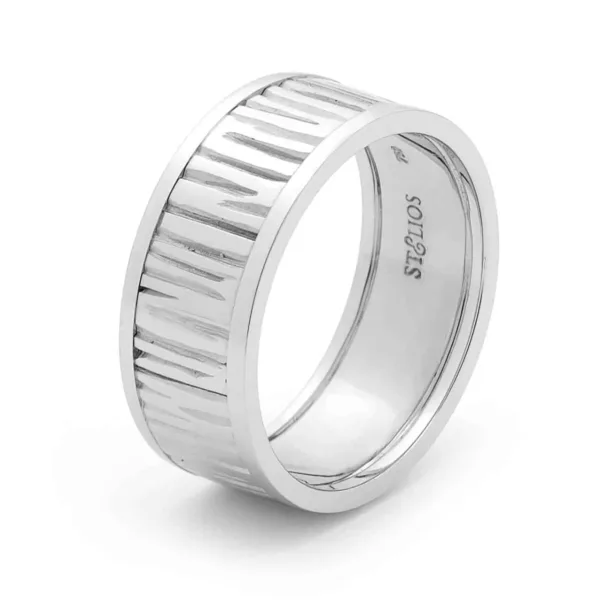
Platinum
The considered choice, and expensive.
Platinum is dense, naturally white so it never needs plating, and highly malleable. It is the standard for fine jewellery for good reason.
The property people misunderstand is how it wears. When platinum is scratched, the metal displaces rather than being removed. Over years this builds a soft satin surface called a patina, and almost no material is actually lost. A platinum ring worn for forty years weighs close to what it weighed new. A gold ring worn the same way has lost measurable metal.
Some people love the patina. Others have it polished back to a mirror finish periodically, which is inexpensive.
Best for: anyone who wants one ring for life and does not want to think about it again. Also the most secure metal for holding stones, if your band has any.
Against: cost, and the weight, which is noticeable and which people either like immediately or never get used to.
Palladium

Platinum’s lighter, cheaper relative.
Same white colour, same lack of plating requirement, same hypoallergenic properties, at roughly half the density. Genuinely a good option and historically underrated.
The complication is that palladium pricing has been volatile over the last decade because of industrial demand from the automotive sector, so the cost advantage over platinum varies with the market rather than being reliable.
Best for: anyone who likes platinum and finds the weight or price uncomfortable.
Gold
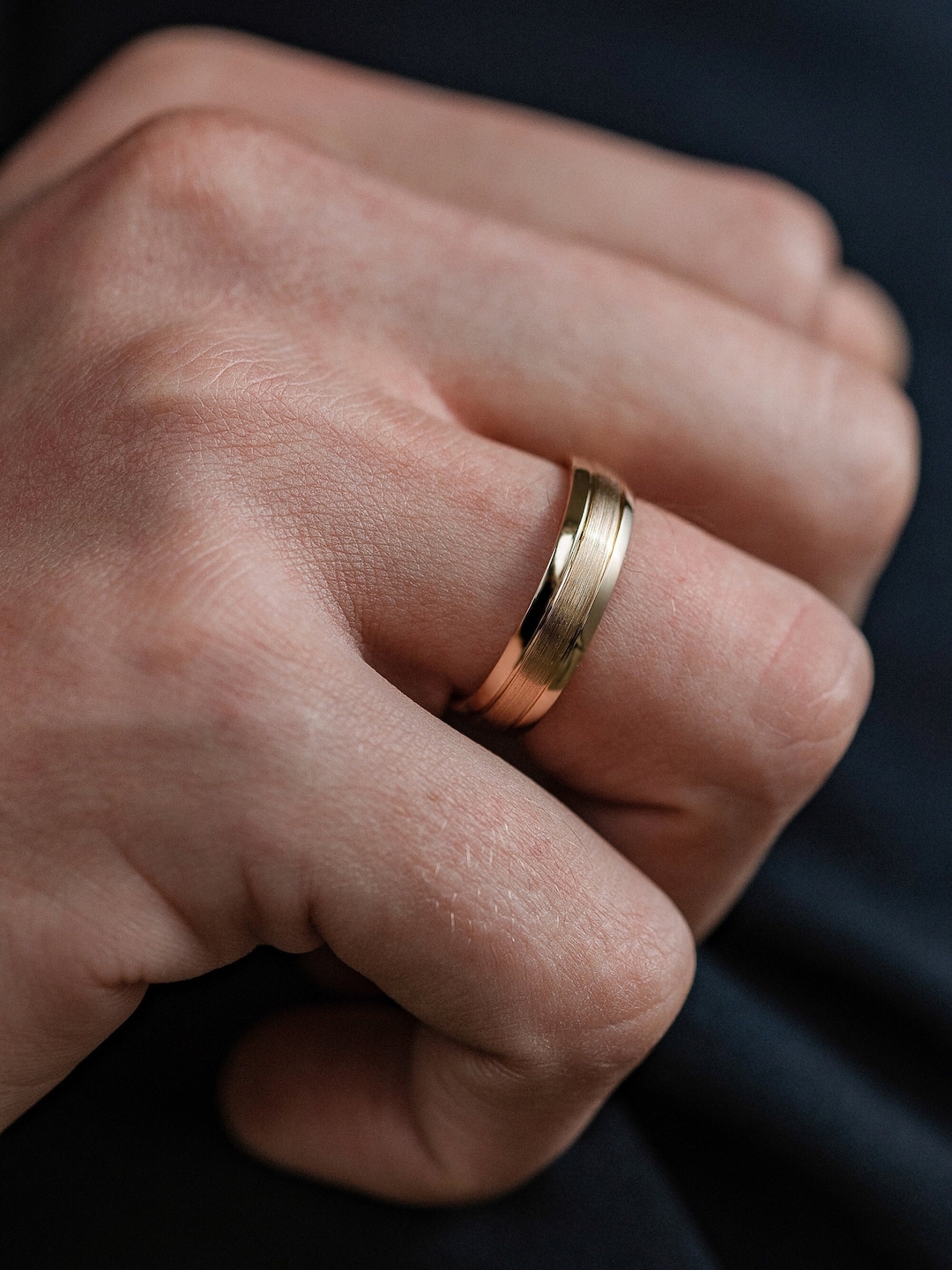
Still the most common choice, and the carat matters more than the colour.
Eighteen carat is 75 per cent gold. Richer colour, holds fine detail well, and the standard for quality jewellery.
Nine carat is 37.5 per cent gold. Harder, cheaper, paler in yellow, and more prone to brittleness at solder joints over decades. It is a legitimate choice and it is a different product.
Yellow is the traditional option and requires nothing but occasional cleaning.
White gold is the one buyers should understand properly. It is yellow gold alloyed with white metals and then plated with rhodium to achieve the bright white finish. That plating wears through over a few years to reveal a warmer tone underneath, and replating is a routine, inexpensive, recurring appointment. Nobody mentions this at the point of sale and it is the most common source of disappointment in the category.
White gold alloyed with nickel can also cause contact dermatitis in people with nickel sensitivity. Palladium-alloyed white gold avoids it.
Rose gold gets its colour from a higher copper content, which also makes it slightly harder than yellow. It has cycled in and out of fashion for a century and is currently in.
Best for: most people. Resizable, repairable anywhere, engravable, and every jeweller on earth can work on it.
Titanium

Light, strong, cheap, and surrounded by misinformation.
Titanium is about half the weight of steel with a distinctive grey tone, excellent corrosion resistance and genuine hypoallergenic properties. It is a good material.
The myth worth correcting: emergency departments can cut off a titanium ring. Standard ring cutters handle it. The story that they cannot has been circulating for two decades and it is simply untrue.
What is true is that titanium cannot be resized in the normal sense, because it cannot be soldered with standard jewellery equipment. Some minor adjustment is possible on some designs. Mostly, if your finger changes, you buy another ring.
Best for: anyone who wants light, tough and inexpensive, and who is comfortable treating the ring as replaceable.
Against: no resizing, limited repair options, and the colour is grey rather than white, which looks different from platinum or white gold next to an engagement ring.
Tungsten carbide
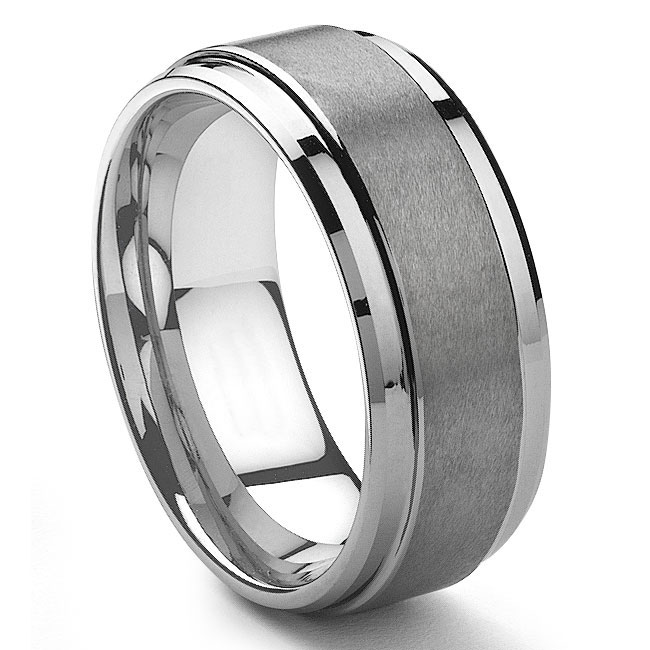
The hardest option, and the most misunderstood.
Tungsten carbide is extremely hard, roughly 8 to 9 on the Mohs scale, which means it holds a mirror polish essentially indefinitely. For anyone who hates the look of a scratched ring, nothing else comes close.
The trade-off is the one in the vocabulary section. Extreme hardness comes with low toughness. A tungsten ring dropped on a tiled floor or struck hard can shatter. This is not a defect, it is a material property, and people are consistently surprised by it.
On removal: a tungsten ring is not cut off, it is cracked off, usually with vice grips applied around the band. Emergency departments do this routinely. It works and it is fast. The ring is destroyed, which is the point.
Cannot be resized. Cannot be engraved deeply, only laser-marked.
Best for: someone who wants a permanently flawless finish and accepts a disposable ring.
Against: brittleness, no resizing, no repair.
Cobalt chrome zirconium and tantalum
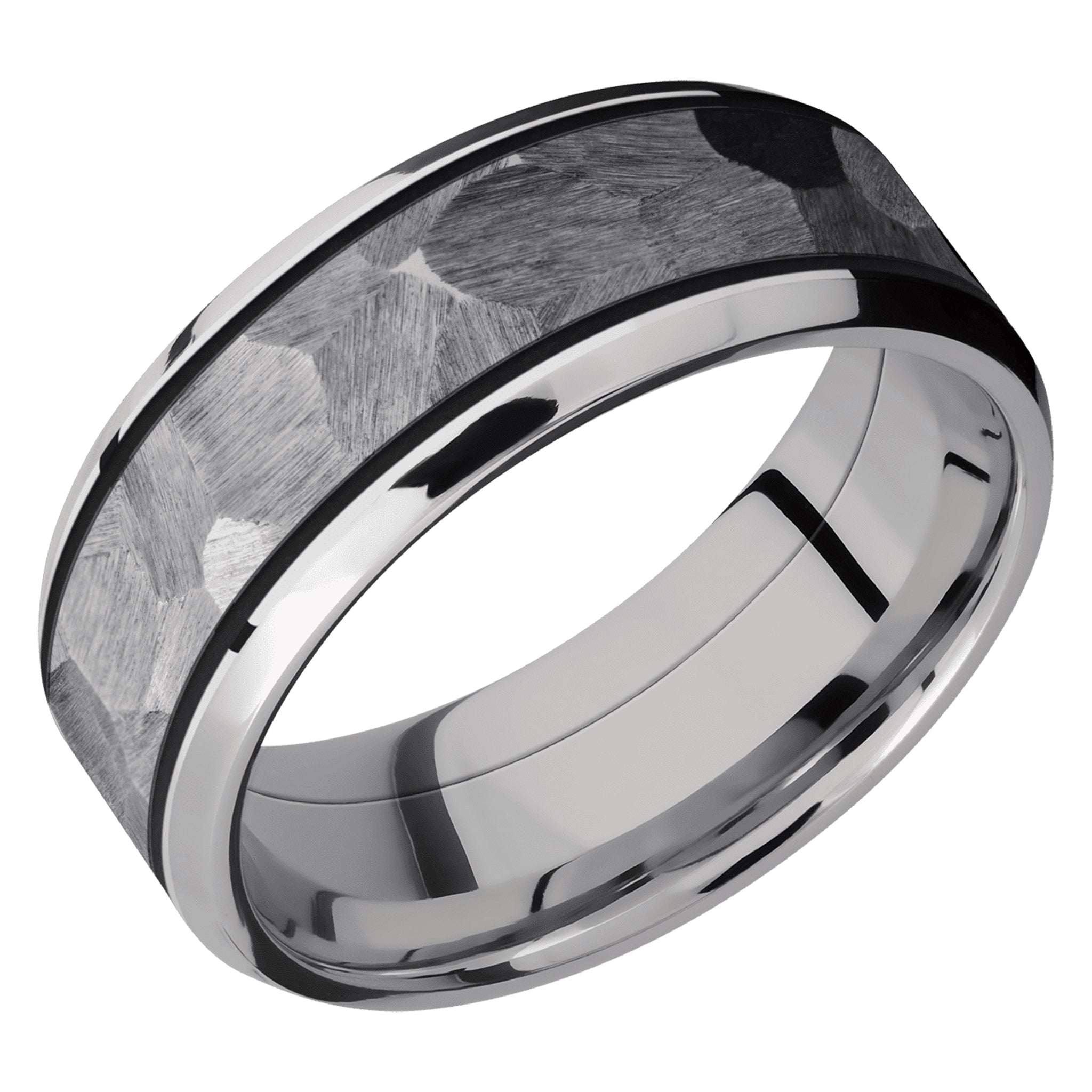
The middle ground, and worth knowing they exist.
Cobalt chrome is white, hard, tough and does not need plating. A reasonable alternative to white gold for anyone who wants that look without the replating.
Black zirconium is zirconium metal with an oxidised surface layer, producing a genuinely black finish that is part of the metal rather than a coating. It wears far better than black plated alternatives.
Tantalum is dark blue-grey, very dense, highly corrosion resistant and unusually tough for a hard metal. Expensive and uncommon, and the people who choose it tend to be very pleased with it.
What to avoid and why
Silver. Too soft for daily wear and it tarnishes constantly. Fine as a placeholder, not as a wedding band.
Ceramic. Attractive and genuinely brittle. Chips visibly.
Plated anything. Black plating on a base metal will wear through at the contact points within a year or two and look worse than either finish alone.
The questions that actually decide it
What do you do with your hands?
Trades, mechanical work, lifting, anything involving machinery: a hard metal makes sense, but consider whether you should be wearing a ring at work at all. Degloving injuries, where a ring catches and strips the tissue off a finger, are the reason many trades remove rings entirely. A silicone band for work and a proper ring otherwise is a common and sensible arrangement.
Office work: anything goes.
Healthcare: something smooth, low profile and easy to clean.
Will your finger size change?
If you have any expectation of significant weight change, choose something resizable. Gold, platinum and palladium resize easily. Titanium, tungsten, ceramic and cobalt largely do not.
Does it need to match a partner’s ring?
Colour matching across metals is straightforward. Hardness matching matters more, and almost nobody raises it. If two rings sit against each other daily, the softer one wears against the harder one over decades. If your partner wears platinum and you wear tungsten, their ring will take the wear.
How do you feel about scratches?
This is a genuine temperament question. Some people want a ring that records the years. Others are bothered by the first mark. Platinum and gold accumulate character. Tungsten stays perfect.
Width profile and fit
More important to comfort than metal choice and rarely discussed.
Width. A two millimetre difference is dramatic on the hand and nearly invisible in a photograph. Most men end up between five and seven millimetres. Try several.
Profile. Flat, rounded, or comfort fit, which has a domed interior so the ring rolls over the knuckle more easily and feels smaller than its width suggests. Comfort fit sizes differently from standard, so get sized in the actual profile you are buying.
Sizing timing. Fingers are larger late in the day, larger in heat and after exercise, smaller in cold. Size in the afternoon.
Finishes and what they cost you in upkeep
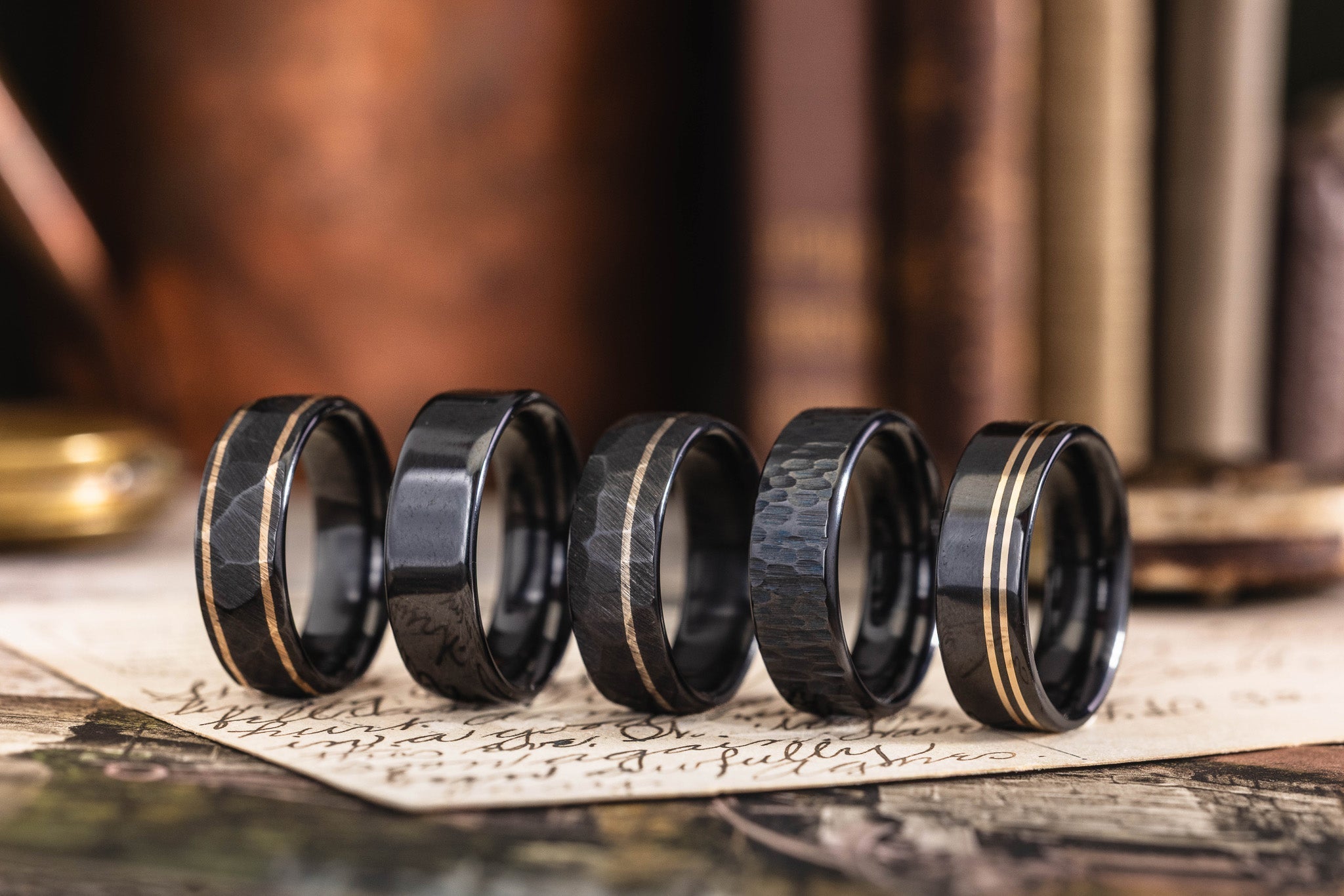
The surface treatment changes the look as much as the metal does, and each behaves differently with wear.
High polish is the default mirror finish. It shows every scratch, but on gold and platinum it also buffs back to new in minutes.
Brushed or satin has a fine directional grain. It disguises wear far better than polish, and it can be refreshed easily.
Matte and bead blasted finishes are flat and non-reflective. They soften over time as contact burnishes the high points, gradually drifting toward a low satin.
Hammered surfaces hide damage better than anything else, because the texture is irregular to begin with.
Two-tone construction, typically a white metal band with a yellow or rose interior or inlay, is a way to get the look you want against a partner’s ring while wearing what you actually like. It also has a practical benefit: the inner surface, which nobody sees, can be the softer and more comfortable metal.
If you are the sort of person who will be bothered by marks, choose brushed rather than a hard metal. It solves the same problem without the brittleness trade-off.
Engraving
Worth planning rather than adding.
Interior engraving has to happen before final polishing, so requesting it after collection means the ring goes back to the bench. Deep hand engraving is possible on gold, platinum and palladium. Laser marking is what you get on titanium, tungsten and ceramic, and it is shallower.
Fingerprint engraving, where a partner’s print is reproduced inside the band, has become common and reproduces well on softer metals.
Whatever you engrave, consider that it will be read aloud by a jeweller in forty years when the ring comes in for repair.
Getting one made
Most men buy from stock, and for a plain band that is entirely reasonable.
Commissioning becomes worthwhile where you want something specific: an unusual width or profile, a mixed metal construction, a matched pair designed together, or interior engraving that is planned rather than added. Studios that make on site can also repair and resize their own work indefinitely, which over fifty years is worth more than it sounds.
Australian workshops working this way for mens wedding bands, Stelios Jewellers among them, will generally make a men’s band alongside a partner’s ring so the pair are designed as a set rather than assembled from two unrelated purchases.
If the two rings are going to sit together in every photograph for the rest of your life, that is a reasonable thing to have thought about.
Budget and what it actually buys
Metal cost varies more than most people expect, and the differences are worth understanding rather than guessing at.
Platinum sits at the top, driven by both metal price and the fact that its density means a band of the same dimensions contains considerably more material by weight. Gold follows, with 18 carat meaningfully above 9 carat for the same reason.
Titanium, tungsten and cobalt sit far below, because the raw materials are inexpensive and the manufacturing is largely machining rather than bench work.
The place people misjudge value is over the long run. A titanium ring bought three times across a marriage, because finger size changed twice, may cost more than one gold band resized twice. A tungsten ring that shatters is replaced. A platinum ring is polished.
Whether that matters depends on how you think about the object. Some people want the same ring on their finger in fifty years. Others are content for it to be a consumable that gets replaced when circumstances change. Both are reasonable and they point to different metals.
The short version
Platinum if you want one ring forever and cost is not the constraint.
Eighteen carat gold for most people, with white gold carrying a replating commitment nobody tells you about.
Palladium as the value alternative to platinum.
Titanium for light, tough and cheap, accepting it cannot be resized.
Tungsten for a permanently perfect finish, accepting it can shatter and will be cracked off rather than cut.
And whatever you choose, get sized in the afternoon, in the profile you are actually buying.